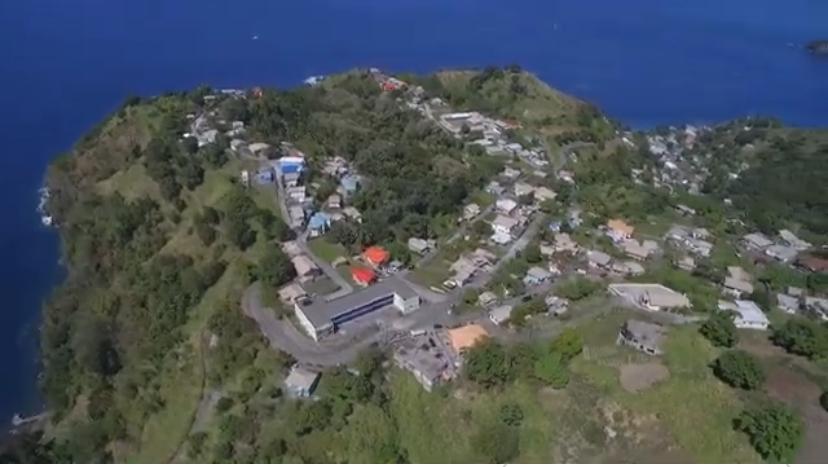
Picture courtesy of Vincycation Adventures
I am uncertain if this is normal or something I should overcome, but I often find myself yearning to seek out remnants of my past – the places I lived, the locations I used to visit, and the activities I once engaged in that shaped my identity. At times, it’s mere curiosity; at others, I want to bask in the joy of reliving the snippets of our culture that still exist, those moments that evoke feelings of nostalgia and warmth. As I drive along the Leeward (Western) side of my beautiful homeland, lush with nature’s green foliage and warm breezes that gently caress my skin, I often gaze at the houses we lived in that still stand strong or the sites I frequently visited during my childhood. For some houses, I wonder – does that house still stand resilient against the elements, or is a stone or rock all that’s left, a mere ghost of memories past? I often ponder what happened to certain individuals or families – where are they now? Some may experience only a fleeting thought or moment of nostalgia, but for me, this longing runs deeper; I crave details, the stories intertwined with each place and person. I frequently reach out to my sister Lexie to inquire about those days gone by, as, despite being ten years my junior, she reliably fills in many pieces of the puzzle about my distant past, providing insights and snippets of conversation that breathe life into the memories I hold dear and help me to reconnect with those fragments of my history.
Our father worked for the government, leading our family to several locations on the island. But my life began in the hilly village of Troumaca; my roots lie on G-Piece Hill, quite literally a hill on top of a hill. Fortunately, our family still owns that land today, allowing me to visit and stand on the ground my great-grandmother once walked upon. Although I never met her, the imagery relayed to me by my mother and grandmother paints a vivid picture of this ambitious and beautiful woman. A farmer who cultivated the land and raised cattle, pigs, and donkeys, Jucilla James (Nenen, as she is affectionately known to us) was undeniably a formidable woman. Humble in her ways, she was famous for having numerous godchildren, many of whom she raised, nurturing them with love and wisdom. She asked for little, only a plea to my grandmother to pay her land taxes and ensure our family never lost the land, a remarkable testament to her enduring spirit. My grandmother echoed this sentiment to her children, embedding that mentality within our family and enabling generations to maintain ownership of the land that connects us to our Nenen.
I still remember my early days in G-Piece with my cousins, sliding down the hill on a coconut branch, pretending we were sailing on a ship, the warmth of the sun on our backs and the laughter ringing in the air. In my mind’s eye, I still see the boys playing cricket on the portion of the hill they excavated to create a cricket field, their shouts of excitement mingling with the sounds of nature. I fondly recall the coconut tree named Stanley Coconut Tree, a monument to my Uncle Stanley, who passed away as a toddler. Erroneously, I believed he was buried under that tree until my mother explained it was his navel string or umbilical cord laid to rest beneath it, an old custom that tied us to the land in a deeply personal way. Back in those days, it was customary to bury the umbilical cords of babies and plant some sort of tree upon it, a practice that served as a comforting reminder of our connections to both family and earth. The landscape of G-Piece was filled with various trees – Jamaican plums, golden apples, coconuts, mangos, and cocoa trees, each holding its own special story and memory. I vividly remember the scent of jumbie Barsum, a wild mint that flourished throughout G-Piece, the way its aroma would mix with the earthy smells that arose after a rain shower.
My grandmother, “Ma St. Hill,” owned a modest home inherited from her mother Nenen, where I was born, a sanctuary filled with warmth and love. That house brimmed with laughter and joy in my childhood; I can still hear the giggles as Ma St. Hill would share jumbie (ghost) stories while we huddled on her lap in her morris/rocking chair, her gentle voice weaving tales that danced between reality and folklore. She would rock us gently as she sang songs, like “Peter was a fisherman,” always ending with her traditional “Aaah ha, Aaah ha,” a sound that brought a smile to our faces and comfort to our hearts. The highlight of our evenings often involved listening to Radio Antilles on the large transistor radio perched prominently atop a shelf in the small living room, filling our minds with the rhythms of the time and the stirring voices that sang through the airwaves. I can still envision my grandmother tucking what seemed like an army of grandchildren into her expansive four-poster bed at night, the laughter fading into delighted whispers as we settled down. The bed strangely felt larger than the small house it occupied; it was a sanctuary of warmth and love, where dreams intertwined with the stories of our ancestors. I am unsure how that bed accommodated so many of us, but we all yearned to sleep next to our beloved Ma St. Hill, drawn together not just by blood but by the stories that wrapped around us like a cozy blanket.
A large water tank stood conspicuously at the side of the small house, a remnant of days gone by when it provided water for the family and neighbors, a lifeline in the heart of our land. My mother eventually installed water pipes on the property, transforming the water tank into a makeshift pool for us to swim in. We would splash around until we were waterlogged, only to be called inside by our grandmother for supper, her voice echoing like a bell, summoning us to the table filled with hearty food. Even today, I remain in awe whenever I stand on that land, envisioning my Ma St. Hill singing hymns slightly out of tune with her aging voice, yet full of love that transcended any musical notes. There was no television or phone; we lived in a world where our imaginations entertained us, and teachers, books, and life experiences educated us, nourishing our minds as much as food nourishes our bodies.
Ma St. Hill had a knack for creating something delicious from whatever the land produced. I remember the wild coffee she ground, the fragrant aroma wafting through the air, blending with the scents of home. The tapioca and madumgo dumplings she baked in her iron pot were a treat, warm and satisfying, and the sweet taste and aroma of her delectable coconut cakes still linger in my memory, a testament to her culinary magic. I still have vivid memories of my mother JC ascending the hill after a day spent processing cassava bread and ferine in the village, laying down her basket filled with ferine and cassava bam bam, a labor of love that brought us all together. Mixing the ferine with sugar, we would indulge in these treats until our little stomachs ached, laughter filling the air as we savored each bite. The next day, we would awaken to the scent of turpentine mangoes, golden apples, and plums, the fruits ripened by the sun offering a taste of heaven. I often ponder where my Nenen acquired that plant; it is not commonly found in St. Vincent, yet arguably one of the most delicious mangoes. As we indulged in the delightful fruit, I can still hear Ma St. Hill’s warning, “Don’t let the stem touch yuh mouth; it will bun yuh mouth,” a voice forever etched in my heart.
Like many families, our lives improved economically, leading us to relocate with our parents to other areas. However, G-Piece always remained in my heart, fostering an unquenchable longing within me, a tether to my roots that I couldn’t shake. Whenever I could, a visit to Ma St. Hill and G-Piece was pure delight, a pilgrimage of sorts that filled my spirit with joy and tranquility. Like moths drawn to a flame, I often gathered with my siblings and cousins there on weekends and school vacations, the laughter echoing through the hills as we played and created memories. Life in G-Piece was simple, playful, and filled with sheer joy, where every corner held a new adventure just waiting to be discovered. On Sundays, my grandmother led us down the hill to the Methodist church where most of us were baptized, the path well-trodden by our eager little feet. At the foot of the hill, we girls would spin in the powerful wind gusts that always swept through that area, reveling in the sound of our dresses’ stiff fabric against the rushing breeze, our laughter mingling with the wind.
Upon entering the church, Ma St. Hill would march her battalion of grandchildren proudly into the two pews she claimed, well aware that other parishioners knew better than to sit there, a testament to the respect she commanded. The village of Troumaca is fortunate to still be adorned with the church that holds countless memories from my childhood. Situated on a hill overlooking the Caribbean Sea, the songs of praise still resonate from my baptismal church on Sunday mornings, filling the air with hope and community. My relatives continue to attend services there, upholding the legacy of our great-grandmother, which soothes my nostalgic soul and links our past to the present.
My immediate family initially moved to the village of Campden Park, where my father worked for the government. I often wonder about the three houses we rented while there, pondering how many of them still stand today. I particularly remember Mother Edwards’ house, perched atop the rocky “Eddy Hill,” a place filled with laughter and stories that lingered like whispers in the wind. I also remember the fear I experienced whenever I passed my old neighbor’s house, who was reported to be a witch, no doubt a legend of the village. I remember running nonstop up the steep hill whenever I went past her house, believing the tale of black magic.
The house on Eddy Hill still stands out as one of my favorites. The expansive parlor welcomed visitors into the front of the large wooden house, with the “jump-up-and-kiss-me” flower thriving among the rocky hilltop, its vibrant blooms imbuing life into our memories. I can still recall using them as makeshift lipstick, giggling with my sisters and cousins, our imaginations turning simple moments into treasured memories. I also remember the gentle old lady who owned the house and lived with us for a month while awaiting a move in with her daughter; she was truly a kind soul, her smile radiating warmth. I felt sad to see her depart, knowing that her presence would linger long after she left.
Among the rocks of Eddy Hill stood my favorite snack: a large Bequia plum tree, its fruit a sugary treat that never failed to please. I would sneak up its branches to gather plums, defying my parents’ warnings about falling into the deep valley below, the thrill of mischief chasing me up the trunk. I can still hear my father’s footsteps at dawn, carrying water up the steep hill during the dry season to refill the tank we used for bathing, cooking, and drinking, a routine that showcased his dedication and hard work for our family. A promotion for my father led us to move to the town of Barrouallie, where our family home remains today. But I distinctly remember the two houses we initially lived in at Wallilabou, a picturesque outskirts of Barrouallie, each house holding echoes of laughter and warmth. I lived there with my family until I moved to the United States, a transition that came with bittersweet memories. Occasionally, I still visit one of these houses, now housing a government office, a reminder of the past wrapped in the fabric of change, but the other is so overgrown with weeds it’s impossible to see through the wild shrubbery, a stark symbol of time’s passage.
Regardless of where I live, Troumaca is ever-present in my thoughts, a ghostly reminder of the beauty and simplicity of life that once was. While the landscape may have changed somewhat, the stories and memories of our beloved Nenen and Ma St. Hill linger over that land, intertwining with my own journey, a rich tapestry that shapes my very being. If I could pen a letter to my great-grandmother Nenen, my grandmother Ma St. Hill, and my mother JC, I would express my gratitude for the stories they shared that ignited my curiosity and left me with such rich oral histories, each tale a thread in the fabric of our existence. I can only hope to honor them by passing on their legacy to future generations, ensuring that the essence of their stories continues to thrive and inspire. As my journey becomes intertwined with modern complexities, I aspire never to lose that sense of wonder and to hold onto the essence of what fuels my eccentric soul, embracing the past while navigating the intricate tapestry of life that unfolds before me.
 Trish St.Hill